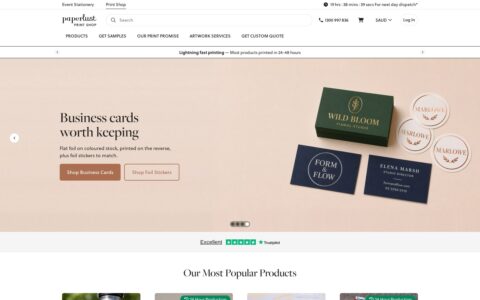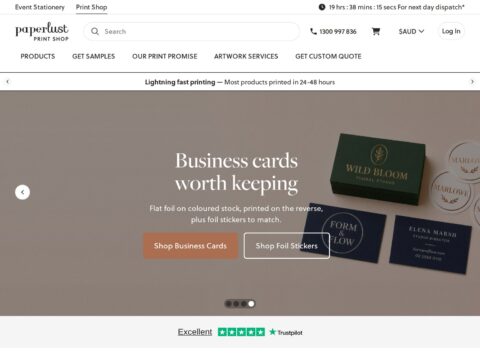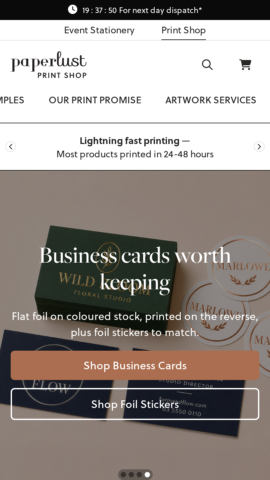
Paperlust Print Shop

Designed for

desktop
tablet
mobile

Brief

Paperlust came back to Krafthaus with a second business to build. The event stationery platform had already become one of Australia’s leading online wedding stationery companies, and the same print supply chain, artwork team and production tooling could serve a completely different customer: small businesses, cafes, trades, property agencies and event companies that need short run printing done properly and done fast.

Rather than bolt a business range onto a wedding brand, Krafthaus built Paperlust Print Shop as a separate storefront with its own catalogue, its own pricing model and its own voice, sitting alongside the original site with a switcher in the header so customers can move between the two.

The store now runs to 86 product pages across 15 categories. The volume sits in custom sticker printing and business card printing, and the range extends through labels, banners, media walls, booklets, flyers, menus, postcards and novelty cheques. Every product is priced live against a quantity ladder, so a customer sees the real per unit rate at each price break instead of filling in a request a quote form and waiting a day for an answer.

The signage side of the catalogue was the most involved piece of modelling. Corflute, PVC, acrylic reception panels, bollard covers and construction site boards each carry their own substrate, size and finish rules, so the custom signage category was built against the real production constraints rather than presented as a flat product list.


The Technical Elements

  • All 86 product pages and 15 category pages are generated from a single catalogue and served fully formed, so Google can index every one. The blog sits under the same domain, so the store and its content work as one site rather than two.
  • Customers choose size, material, finish and quantity, and the price updates live from the same system that runs the print floor, with the per unit rate shown at every quantity break. Anything outside the standard options goes through a custom quote flow, and sample packs can be ordered.
  • Checkout runs through Stripe, and a won job automatically raises the invoice in Xero and a production card in Trello, so nobody retypes an order. Customers upload artwork directly, and an assisted artwork service covers anyone without print ready files.
  • Catalogue search gets customers to the right product in a few keystrokes, supported by Trustpilot reviews and live chat throughout the store, with spam protection on the enquiry forms.
  • The store runs on Amazon's cloud behind a global delivery network, so pages and images load fast wherever customers are. Every change ships through an automated pipeline and is tested first on a mirror of the live site, with an automated suite covering catalogue, search, cart and checkout.

Additional Consideration Given

Print buyers compare before they commit, so the category pages were built as landing pages rather than bare product grids. Products stay above the fold, and the specification tables, turnaround and stock explainers, finish comparisons and FAQ content sit underneath, where they support the decision without getting in the way of it. The content layer was planned around the questions print customers actually search for before they buy: paper and poster sizing, the difference between kiss cut and die cut, what makes a sticker waterproof, how to set up a file for foil. Each article links through to the product that answers it. The most recent addition to the catalogue is a canvas and framed print range, built on the same production tooling and launched in August 2026. The store is optimised for mobile, desktop and tablet, and most products are printed within 24 to 48 hours.